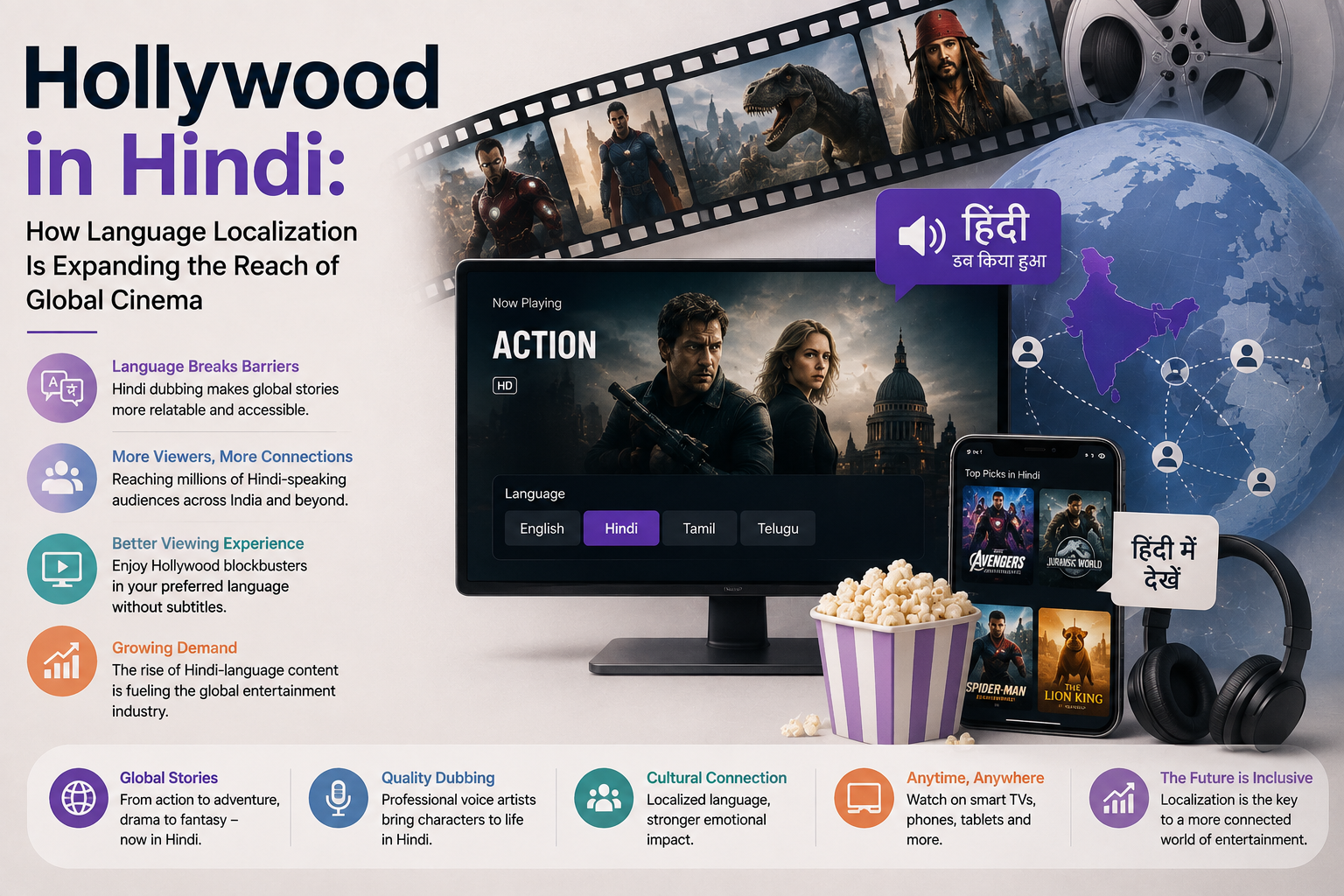
Hollywood has long been an important part of India’s entertainment landscape, but the way Indian audiences experience international cinema has changed considerably. English-language releases are increasingly presented alongside Hindi and other Indian-language versions, making global productions accessible to viewers with different linguistic preferences. For audiences looking for हॉलीवुड फिल्में हिंदी में, digital access provides a particularly convenient way to explore international cinema while keeping Hindi at the center of the viewing experience.
Hindi Has Become a Major Gateway to International Cinema
Hollywood’s position in India cannot be explained simply by the popularity of English-language releases. Localization has become an important part of the industry’s reach, allowing international productions to connect with audiences who prefer Indian languages.
Recent market evidence illustrates how significant this strategy has become. In July 2026, The Economic Times reported that dubbed versions of Christopher Nolan’s films could account for as much as 30% of their Indian box-office collections, with Hindi, Tamil, and Telugu versions helping expand their audience beyond traditional English-speaking urban viewers.
This reflects a broader change in the Indian entertainment market. Hindi dubbing is no longer simply an additional option for international releases. For many viewers, it is the most natural way to experience Hollywood cinema.
The result is a wider potential audience for global films, while Indian viewers gain greater freedom to choose the language in which they consume international entertainment.
Dubbing Makes Global Cinema More Accessible
Language can be one of the biggest barriers between an audience and international content. Subtitles solve part of that problem, but they require viewers to read translated dialogue throughout the film. Hindi dubbing offers a different experience by allowing audiences to hear the dialogue in a familiar language while concentrating entirely on the visual presentation.
This can be particularly useful for family viewing, where different members may have different levels of English comprehension. Hindi audio can also make international cinema more approachable for younger viewers and audiences who simply prefer watching entertainment in Hindi.
The expansion of dubbed content across Indian markets suggests that localization is becoming an integral part of film distribution. India’s Ministry of Information and Broadcasting has even issued communications concerning the certification process for Hindi-dubbed films, reflecting the established role of localized versions within the country’s film ecosystem.
For viewers, the practical outcome is greater choice without requiring them to compromise on access to international cinema.
Hollywood’s Indian Audience Is More Diverse Than Ever
Hollywood’s Indian audience is no longer concentrated exclusively in major metropolitan areas or among English-speaking viewers. The expansion of digital connectivity has created opportunities to reach audiences across different regions, languages, age groups, and viewing environments.
Hollywood’s share of India’s theatrical market generally remains smaller than that of Hindi cinema, but it still represents a substantial part of the country’s overall film consumption. During the first half of 2026, international films accounted for approximately 8% of India’s box-office revenue, according to Ormax data reported by The Indian Express.
That figure becomes more meaningful when considered alongside dubbing. Hindi-language versions allow international productions to move beyond the audience that would normally watch Hollywood films in English.
Digital distribution can take this process even further by making localized entertainment easier to discover outside the country’s largest cinema markets.
From Imported Entertainment to Localized Streaming
For previous generations, audiences often encountered Hollywood through television broadcasts, cinema screenings, or physical DVDs. The availability of a particular language version depended heavily on local distributors and broadcasters.
Streaming has changed that model. Modern digital catalogs can present international entertainment alongside localized audio and subtitles, making language part of the discovery process rather than something audiences have to search for separately.
India’s Ministry of Information and Broadcasting currently maintains a large registry of OTT platforms operating in the country, illustrating the scale and diversity of the country’s digital-video ecosystem.
This environment makes it easier for audiences to move between Hollywood and Indian cinema within the same digital culture. A Hindi-speaking viewer can explore international productions without leaving behind the language they normally use for entertainment.
The distinction between “foreign content” and “local viewing” therefore becomes increasingly flexible.
A Broader Hollywood Catalog Through Hindi
Hollywood is not a single genre. International cinema includes action, science fiction, fantasy, comedy, drama, thriller, mystery, animation, family entertainment, historical productions, and many other formats.
Hindi localization makes this variety more approachable because viewers can explore different categories without needing to switch their preferred language. A viewer interested in science fiction can remain within a Hindi-language selection, while another may prefer comedy, animation, thriller, or family entertainment.
This creates an important role for catalog organization. When an online collection contains international titles from many genres, intuitive shelves and clear categories can help viewers find relevant content without having to know specific titles beforehand.
The best digital experience supports both purposeful searches and casual discovery. Someone can arrive looking for a particular movie or simply browse the catalog until something catches their attention.
The Digital Shelf Is Changing How Hollywood Is Discovered
Traditional television schedules once played a major role in deciding when audiences encountered Hollywood films. A broadcaster selected a title, assigned a time, and determined when viewers could watch it.
Online catalogs reverse this relationship. The audience controls the timing and can explore content according to personal availability.
This is particularly useful for localized Hollywood cinema because viewers may want to compare different genres or language options before deciding what to watch. A well-organized digital shelf allows that exploration to happen naturally.
The broader Indian streaming market is moving in this direction. Industry analysis from the Ministry of Information and Broadcasting highlights the growing importance of language-specific online content and the expansion of India’s multilingual OTT environment.
Hindi-dubbed Hollywood content fits naturally into this ecosystem because it combines international production with a familiar language of access.
A More Direct Route From Browsing to Playback
The convenience of streaming depends heavily on what happens after a viewer finds something interesting. Complicated registration requirements, excessive redirects, and intrusive advertising can make even a large catalog difficult to use.
Moviewala’s Hindi catalog is designed around a more direct experience. Viewers can browse the available international entertainment, select a title directly from the shelf, and move toward playback without a mandatory registration wall. The absence of annoying pop-ups also keeps the interface focused on content discovery.
This frictionless approach is particularly valuable when browsing unfamiliar Hollywood titles. A viewer can explore one category, return to the shelf, investigate another option, and make a decision without repeatedly encountering unnecessary barriers.
One-click access reduces the distance between curiosity and viewing. The catalog remains the primary interface, while the technical process of starting a film stays largely invisible.
Hollywood Across Smart TVs, Laptops and Mobile Screens
The modern Indian audience is increasingly accustomed to switching between devices. Smart TVs provide a natural environment for home cinema, while laptops and desktops offer flexibility for individual viewing. Smartphones and tablets provide access in more portable situations.
The growth of digital entertainment has made this multi-screen behavior particularly important. A Hollywood film can now be discovered on a phone, selected from a laptop, or watched on a large television without the viewing experience being tied to one physical location.
For Hindi-language streaming, responsive design is equally important. A content shelf needs to remain easy to understand on a large television while navigation and playback controls must remain practical on smaller screens.
A premium platform should make these differences feel almost invisible. The viewer changes the screen, but the basic relationship with the catalog remains consistent.
The Technology Behind High-Quality Localized Playback
Streaming international cinema requires substantial technical infrastructure. A modern platform needs to manage high-resolution video, multiple audio tracks, subtitles, metadata, and different device configurations while delivering content across networks with varying speeds.
Video compression helps reduce the data required for transmission, while adaptive streaming can adjust playback according to available bandwidth. Content delivery networks can distribute media more efficiently across different geographic regions.
Localized content adds another layer because a single film can have several language versions. Hindi audio may exist alongside original English dialogue and other Indian-language tracks, requiring efficient media management behind a simple user interface.
For the audience, none of this should become a technical problem. The desired experience is straightforward: select a Hindi-language Hollywood title, start playback, and enjoy consistent picture and sound quality without having to manage the underlying infrastructure.
Localization Is Becoming a Core Part of India’s Film Economy
The importance of language localization is visible well beyond individual films. India’s entertainment market increasingly treats multilingual access as a fundamental part of reaching audiences.
Hollywood’s current performance in India demonstrates why this matters. During the first half of 2026, international cinema accounted for a meaningful share of the national box office, while major releases continued to benefit from Hindi and regional-language versions.
At the same time, streaming has expanded the number of ways international content can reach Indian viewers. Digital platforms can offer localized entertainment alongside Indian-language productions, creating an environment where audiences do not have to choose between global cinema and linguistic familiarity.
Hindi therefore functions as a bridge rather than a barrier. It allows international entertainment to retain its global identity while becoming more comfortable for a large Indian audience.
The Future of Hollywood in Hindi
The relationship between Hollywood and Hindi-speaking audiences is likely to become even more sophisticated as streaming, dubbing technology, connected television, and multilingual interfaces continue to develop.
The increasing use of Hindi versions demonstrates that localization is not simply a secondary distribution feature. It can materially expand the audience for international cinema. At the same time, digital catalogs make it easier to organize this content around language, genre, device, and personal viewing habits.
Accessibility is also becoming more prominent within India’s streaming environment. In March 2026, the Ministry of Information and Broadcasting introduced guidelines for OTT platforms addressing features intended to improve access for viewers with hearing and visual impairments. This points toward a broader definition of premium streaming in which convenience includes language accessibility as well as straightforward navigation and playback.
The ideal experience remains uncomplicated. Open the Moviewala Hindi catalog, explore the Hollywood selection, choose a title directly from the shelf, and press play. With high-quality playback, one-click access, no registration wall, and no distracting pop-ups, the digital environment can make global cinema feel considerably closer to Hindi-speaking audiences while keeping the viewing experience simple and unobtrusive.